
My Husband Laughed When I Said the Washing Machine Smelled Like Dog — But When He Leaned In and Took a Sniff, He Went Quiet.
The hidden reason your “freshly washed” clothes still smell like your pet — and why your detergent has never been able to fix it.
By Sarah Callahan
Contributing Writer, Home and Lifestyle | February 14, 2026 • 14 min read
She pulled the duvet cover out of the dryer warm, folded it while it was still hot, and carried it straight to the bedroom. Fresh laundry smell. Clean sheets. The small satisfaction of a Sunday done right.
She climbed into bed that night and noticed it immediately.
That smell. Faint, but unmistakable. Somewhere between damp dog and a room that hadn’t been aired out. Not dirty, exactly. Just… not clean.
She’d washed everything on a hot cycle. Used extra detergent. Even ran the drum clean cycle the week before.
“Where is it coming from?”
If you own a pet and have ever asked yourself that exact question, this article is for you.
“I've tried every detergent and the smell is STILL there. It’s disheartening.” — pet owner, via Reddit
The Problem Nobody Talks About
Most people focus on the visible side of the pet hair problem: the fur on the couch, the strands on a black blazer, the lint roller kept in the car “just in case.”
But there is a second problem quietly developing inside the one appliance you rely on to clean everything.
Your washing machine. And specifically: what is living inside it.
Every time you wash pet bedding, towels, or clothes covered in fur, a portion of that hair — along with the dander, bacteria, and moisture it carries — doesn’t leave with the rinse water. It stays. It accumulates in the drum seal, the gasket folds, the pump filter, and the inner walls of the machine itself.
Over weeks and months, that accumulation builds into a layer of organic material: hair, dander, skin cells, and the bacteria that feed on all of it. It sits in the warm, damp interior of your washing machine between cycles. It starts to smell.
And then, on the next wash, your “clean” clothes run through it.
I couldn’t figure out why my laundry smelled even after washing. Turns out the machine itself was the problem.”
Why Your Detergent Has Never Fixed This
Standard laundry detergent is formulated to clean fabric. It targets oils, dirt, and surface-level grime on the clothes themselves. It was not designed — and is not able — to break down the compacted layer of pet hair, dander, and bacterial biofilm that accumulates inside the drum and gasket of a washing machine.
Think about what happens during a normal wash cycle. Water and detergent circulate through the drum, cleaning the clothes. But that same water also passes through every part of the machine where buildup has accumulated — including the door seal folds, which in a front-loader can trap significant amounts of hair and moisture — and then flows back over the clothes you’re trying to clean.
You are, in effect, washing your clothes inside a machine that is itself not clean.
The smell is the most obvious symptom. But it’s not the only one.
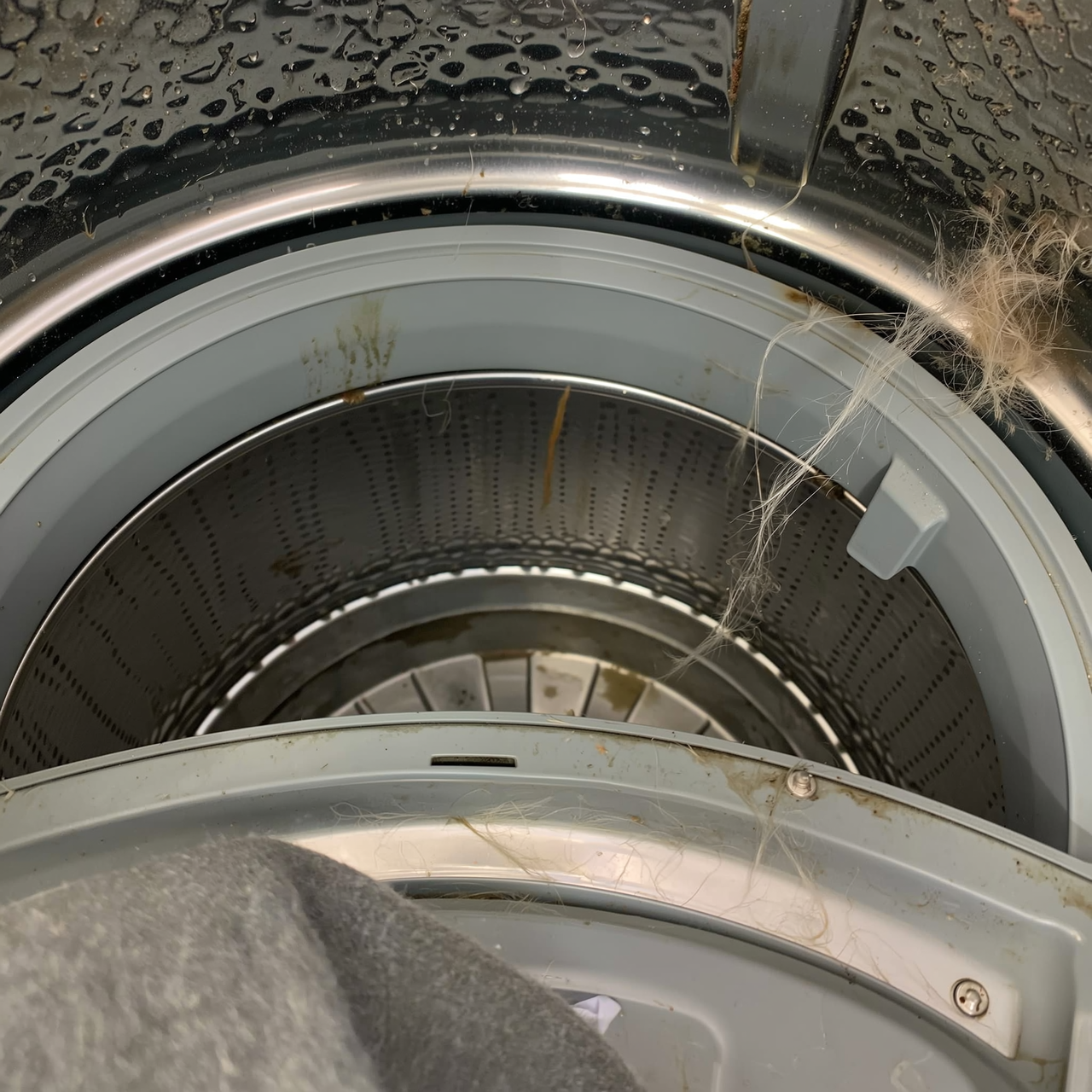
“Pet hair can obstruct pump filters, and hair buildup in gaskets creates a warm, damp environment where bacteria and mold thrive. Most owners don’t realise the machine is the source of the odor, not the laundry.” — appliance maintenance guidance, Maytag
What's Actually Building Up In Your Machine
Pet hair is not just hair. Under a microscope, an animal hair strand has a scaly, barbed surface structure — which is why it clings to fabric and resists flushing. When that hair makes it into your washing machine, those same barbs allow it to anchor to rubber seals, gasket folds, and drum surfaces instead of draining away cleanly.
Once lodged, pet hair acts as a net for everything else passing through the machine: dander (the microscopic skin flakes that carry most pet allergens), bacteria from soiled laundry, mineral deposits from water, and detergent residue that didn’t fully rinse.
In a front-loading machine, the rubber door gasket is the primary accumulation site. The fold of the seal creates a warm, perpetually damp cavity where hair and organic material collect. In a top-loader, the drum rim, agitator base, and pump filter play similar roles.
Left unaddressed, this buildup creates two problems that compound each other:
Odor transfer. Bacteria feeding on organic material in the machine produce the musty, animal smell that survives the wash cycle and lingers on “clean” laundry. No amount of detergent or fabric softener applied to the clothes themselves will fix a smell that is being reintroduced by the machine.
Performance degradation. Hair and debris in the pump filter reduces drainage efficiency. Buildup in the drum and gasket can affect seal integrity over time. Appliance guides consistently note that neglecting this kind of maintenance leads to longer-term mechanical issues, including pump blockages and odor that becomes structural.
“I was using more and more detergent trying to get rid of the smell. It wasn’t the detergent that was the problem.” — pet owner, via laundry forum
What Has to Happen for the Machine to Actually Get Clean
Fixing the odor and buildup problem requires addressing it where it lives — inside the machine, during the wash, at the source. That means three things happening together:
Breaking down the hair and organic buildup. Pet hair is composed of keratin — a protein structure that does not dissolve in water. Dislodging it from rubber seals and drum surfaces requires an active enzymatic or chemical process that targets keratin bonds and loosens the mechanical grip of the hair’s barbed structure.
Neutralizing the bacteria and odor at the source. Surface-level fragrance — whether from detergent or fabric softener — masks smell temporarily. Eliminating it requires targeting the bacterial colonies living in the buildup. An anti-bacterial active that can penetrate organic material and disrupt bacterial cell function is what the machine actually needs.
Flushing the loosened material out of the machine. Hair and debris that has been broken down still needs to be suspended in the wash water and carried out through the drain. Without a surfactant system designed to keep this material in suspension (rather than allowing it to resettle on drum walls or recirculate through the load), the cycle ends with the same problem it started with.
All three steps. In the right sequence. Inside the machine, not on the clothes.
This is why a drum clean cycle with regular detergent doesn’t solve it. It’s also why washing the clothes on a hotter cycle doesn’t fix the smell. And it’s why the gasket of a front-loader that’s been running pet loads for six months can still smell like a kennel the day after you wiped it down.
The Appliance Engineer Who Got Tired of Diagnosing the Same Problem
Dr. Miriam Voss didn’t set out to solve the pet owner laundry problem. She was an appliance and textile research engineer who spent years consulting on washing machine performance failures when she noticed something that kept recurring in her casework.
“Again and again, the complaint was: laundry smells even after washing. Or: machine smells and we can’t get rid of it. And in the majority of pet-owner households, the root cause was the same thing — biological buildup in the machine that standard products weren’t designed to address,” she said.
“The appliance industry had good guidance on mechanical maintenance. But there was a gap between what the machine needed to stay clean and what laundry products were actually formulated to do. Detergent cleans clothes. Nothing on the market was specifically designed to clean the machine of pet hair and organic buildup during a normal wash cycle.”
She spent two years developing a tablet formulation that could do all three things simultaneously — break down keratin-based pet hair, neutralize odor-causing bacteria at the source, and flush the loosened material through the drain — in a standard wash without any additional steps or cycles.
“The goal was simple: add one tablet to a normal load and have the machine come out as clean as the clothes.”
“Detergent cleans clothes. Nothing was designed to clean the machine itself of pet hair and biological buildup. That’s the gap we set out to close.”
How the Three-Phase Process Actually Works
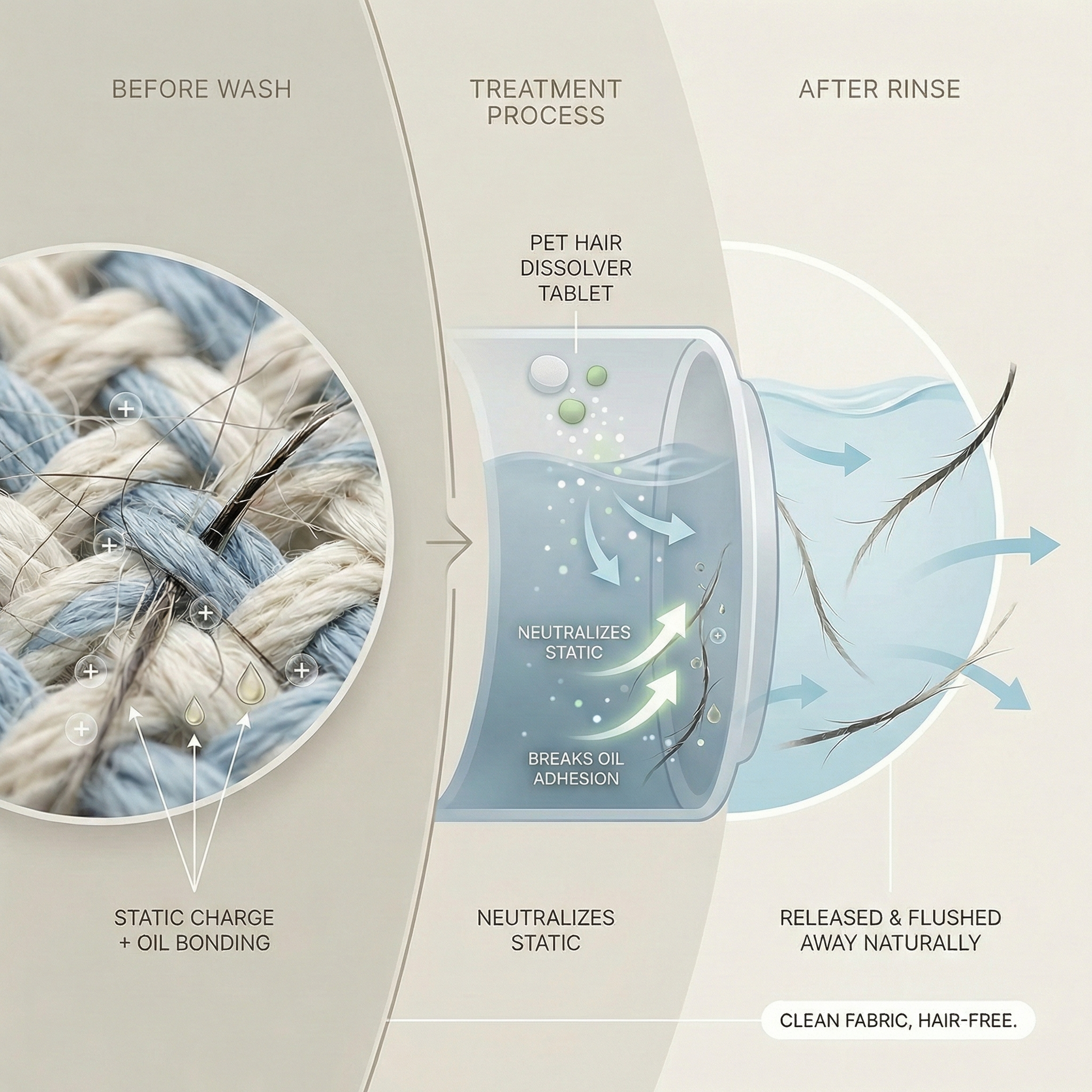
The tablet dissolves in any standard wash cycle alongside regular detergent. From there, it works in three phases that correspond directly to the three reasons the machine builds up and the laundry retains odor.
Phase one: keratin breakdown. The formula releases enzyme compounds specifically active against keratin — the protein that makes pet hair structurally resistant to water. As the tablet dissolves, these enzymes begin working on accumulated hair in the drum, gasket, and seal areas, loosening the mechanical bond that keeps hair anchored to rubber and drum surfaces. Hair that was embedded begins to detach.
Phase two: bacterial neutralization. Simultaneously, the formula’s anti-bacterial actives penetrate the organic layer that has built up in the machine’s interior surfaces. Rather than masking odor with fragrance, this step targets the bacteria producing it. The musty, animal smell that survives standard washing is produced by bacterial colonies living in the buildup — this is what eliminates them at the source.
Phase three: suspension and flush. Once hair is loosened and the biological layer is disrupted, the formula’s surfactant system suspends the freed material in the wash water. It keeps it in suspension through the rinse cycle and carries it out through the drain. This is the step that prevents redeposition — stopping loosened debris from resettling on drum walls, recirculating back into the load, or sitting in the pump filter.
“You’re not just cleaning the clothes. You’re cleaning the environment the clothes are being washed in. Do both at the same time and the smell stops coming back.” — Dr. Voss
I Ran Four Loads. Here’s What Changed.
I have a three-year-old Golden Retriever named Hazel and a front-loading washing machine that I have periodically wiped down, run drum clean cycles on, and doused with white vinegar in an attempt to get rid of the smell. None of it lasted more than a week.
I agreed to test the tablets across four consecutive wash loads.
Load one: Hazel’s blankets and a dog towel. These are the items I dread most because they go in smelling like dog and historically come out smelling like… slightly less dog. I added one tablet alongside my normal detergent. When I opened the machine after the cycle, the gasket — the rubber seal I’d wiped down dozens of times — had visible debris loosened into it. Hair and brownish buildup that had clearly come off the drum interior. The blankets came out genuinely odour-free for the first time I can remember.
Load two: Towels and bath mats — the items Hazel uses after a walk and that carry the heaviest dander load. After washing, no smell. I buried my face in a towel (as one does when testing laundry products at 7pm on a Wednesday) and got nothing except clean. I checked again the next morning, expecting the smell to return as they cooled. It didn’t.
Load three: A regular clothes load — the kind I’d never noticed smelling particularly animal-like, because I’d normalised it. Washing with the tablet and then wearing a hoodie from this load, I noticed something: I couldn’t smell anything. Not dog, not the faint musty undertone I’d come to accept as just… how laundry smelled at our house. It was gone.
Load four: Bedding. The duvet cover, pillow cases, fitted sheet. I’d started this whole experiment because of the smell in the bedding. Load four came out and I stood in the laundry room and smelled the duvet cover for longer than was probably necessary. It smelled like fabric. Clean fabric. Nothing else.
“I buried my face in the towel and got nothing except clean. I checked again the next morning, expecting the smell to return. It didn’t.”
The Questions I Had Before I Tried It
Will it damage my machine or void the warranty? No. The formulation is safe for all standard washing machine types including front-loaders, top-loaders, and high-efficiency machines. The enzyme and surfactant compounds are the same class used in professional appliance maintenance products.
Is it safe for clothes? Yes. The tablet is designed to be used alongside regular detergent in a standard mixed load. It is fabric-safe across cotton, synthetics, wool blends, and delicates. The enzymatic activity targets keratin in accumulated hair — not in the weave of your garments.
Is it safe for pets? Yes. No active residue remains on fabric post-rinse. The formula was developed with pet households specifically in mind, with sensitivity to skin contact and inhalation as core requirements.
What about just running a drum clean cycle? Drum clean cycles use hot water and (usually) a machine cleaner tablet to address visible mould and mineral deposits. They are not formulated to break down compacted pet hair in gasket folds or to neutralize the bacteria living in organic buildup. They’re also an additional step, an empty cycle, and an extra cost. This works during a normal wash load with clothes in it.
How often do I need to use it? One tablet per load that includes pet items — bedding, towels, blankets, clothes with heavy fur. For lower-intensity loads, use as needed. The goal is to prevent buildup from accumulating between washes, not to periodically treat a machine that’s already heavily built up.
Will it work on a machine that’s already badly built up? Yes, though very heavy buildup may require two or three loads to fully clear. Pet owners who describe years of smell they’ve been unable to fix typically report a clear improvement by load two or three, with the full effect established by load four.
“I’d accepted that our house had a certain smell. Then I realised it was coming from the washing machine. Two loads in and it was gone.” — verified pet owner review
Why Thousands of Pet Owners Are Making the Switch
“I thought I needed a new washing machine. The smell had been there for two years. Three loads of this and it’s completely gone.”
“My partner kept saying the towels smelled like dog no matter how many times I washed them. I started using this and he noticed the difference before I told him what I’d changed.”
“I have two huskies and I had genuinely given up on the laundry smell being fixable. It’s fixable.”
“The gasket on my front loader was something I just cleaned and accepted and cleaned again. First load with this and it came loose. Like, it actually detached from the rubber. I didn’t know that was possible.”
“Finally something that treats the machine, not just the clothes. That’s what I’d been looking for.”
The pattern is consistent: people who had accepted the smell as an inevitable cost of life with a pet, discovering that the machine itself was the source — and that addressing it was simpler than they expected.
The Smartest Load of Laundry You'll Ever Run
If you’ve read this far, you’ve probably already identified the source of the smell. It’s not the detergent you’re using. It’s not how often you’re washing. It’s the machine itself — and specifically, the layer of pet hair, dander, and bacteria that’s been building up inside it every time you’ve run a pet load without anything formulated to address it.
Standard products cannot fix this because they were not built to. Detergent cleans fabric. Drum clean cycles address mould and scale. Nothing in the standard laundry toolkit is designed to break down compacted pet hair from gasket folds and drum walls, neutralize odor-causing bacteria at the source, and flush the loosened debris out through the drain in a single cycle.
Until now.
For a limited time, first-time orders include a 30-day money-back guarantee. If your laundry doesn’t come out measurably cleaner after the first load, you pay nothing.
Thousands of pet owners have already stopped accepting the smell as permanent. The towels are clean. The bedding doesn’t carry that faint animal undertone anymore. The gasket stays clean between wipes.
He laughed when I said the machine smelled like dog.
He went quiet when he leaned in and realised I was right.
This time, the machine — and everything that comes out of it — just smells clean.
→ Try the Tablets Risk-Free — 30-Day Money-Back Guarantee
About the Author
Sarah Callahan is a contributing writer covering home, lifestyle, and consumer products. She lives in Portland, Oregon with her husband and a Labrador named Biscuit